
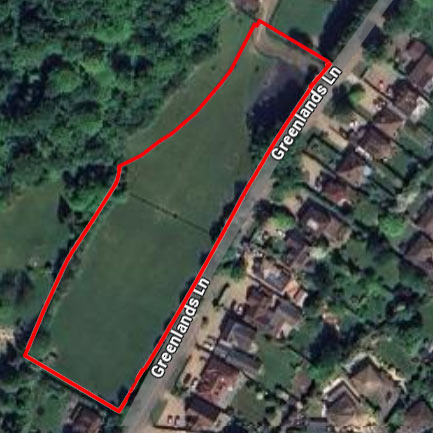
In August 2025, PCA submitted comments to the Planning Application for 18 dwellings, including 9 affordable units, on Greenlands Lane (PL/25/1732/OA). We also published our observations on a web post.
Permission was refused by the Council, but as expected, it has been taken to appeal. The appeal will be presented at a Hearing when both sides can represent their case. Adjudication will be made by an Inspector appointed by the Secretary of State (for the Ministry of Housing, Communities and Local Government).
Documents from the original application, including all comments, are made available to the Inspector. However, the appellants have submitted additional evidence, so the public is able to add further comments.
Closing date for submission of comments is 11.59pm on Thursday 5th June.
The relevant web link is: https://appeal-planning-decision.service.gov.uk/comment-planning-appeal/appeals/6007290
PCA’s Comments submitted to the Appeal
PCA has made the following submission, approved by a majority of the PCA Committee:
Prestwood Community Association
Prestwood Community Association (‘PCA’) is a voluntary, not-for-profit group working with and for residents and stakeholders of Prestwood. We seek to share visions and ideas for a strong, caring, happy and resilient village.
PCA conducted a survey of Prestwood residents and stakeholders across April and May 2026. This confirmed that the Green Belt and National Landscape (now AONB) and the rural/village character of Prestwood area are characteristics extremely highly prized by Prestwood’s residents. This is a consistent thread with several previous consultations of residents.
There is significant concern that, should this development be permitted, it will open the door to significant permanent damage to the character of the village and its setting within the Chilterns National Landscape.
PCA’s previous comments under PL/25/1732/OA will have been forwarded to the Appeal Inspector and these continue to stand.
We should like to add some further observations, having studied the revised materials from the Appellants.
Major Development in National Landscape
The Appellants argue that the question of allowing their appeal hinges almost entirely on whether the site represents Previously Developed Land and qualifies as grey belt, and whether the specific site under consideration exhibits enough of the key characteristics of the Chiltern National Landscapes.
It is obvious to us that they are seeking to sidestep another key determinant, by defining the application as not being a major development. This is critical. NPPF Annex 2, Glossary defines a major development as “For housing, development where 10 or more homes will be provided, or the site has an area of 0.5 hectares or more.”
Para 189 of the updated NPPF states that “Great weight should be given to conserving and enhancing landscape and scenic beauty in National Parks, the Broads and National Landscapes which have the highest status of protection in relation to these issues.”
Para 190 states “When considering applications for development within National Parks, the Broads and National Landscapes, permission should be refused for major development other than in exceptional circumstances, and where it can be demonstrated that the development is in the public interest.”
Thus under the updated NPPF, the applicants need to prove that THIS PARTICULAR DEVELOPMENT meets the standard of being exceptional, and in the public interest, when weighed against other considerations.
The applicants assert time and again that the current proposal at Greenlands Lane is NOT a major development (see inter alia Appeal Statement paragraphs 83, 98, 99, 101). In making this assertion it cites Appeal Ref: APP/X0415/W/18/3202026, Land to the rear of the Old Red Lion, High Street, Great Missenden, HP16 0AU (Decision date: 4th September 2018).
The Inspector, who allowed the Old Red Lion appeal, explained very clearly that “it is for the decision maker to determine whether or not a proposal constitutes major development, taking account of the proposed development’s nature, scale and setting and whether it could have a significant adverse impact on the purposes for which the area has been designated or defined.”
Apart from being within the AONB (National Landscape), the Old Red Lion site was radically different from the Greenlands Lane site. Located within the village of Great Missenden (described in the appellants’ Statement of Common Ground as “one of the built up areas within the Chiltern and South Bucks area of Buckinghamshire Council”), very enclosed by mature trees on three boundaries, and by existing buildings on its fourth, it really did little to contribute to the special characteristics of the AONB. The Inspector cited the Chiltern & South Bucks Townscape Character Study which “identified the site as forming part of the ‘tightly formed centre’ character area, and as having the potential for change. Such areas are noted as having the potential to be improved in terms of their quality and positive contribution to the overall quality of the character area they sit within”.
Therefore the Old Red Lion site, on which the appellants rely for its assertion that this development is not a major development, could hardly be more different from the Greenlands Lane site.
The legal opinion by S P Randle KC, PL_25_1732_OA-LEGAL_OPINION-5076617.pdf, as part of the original application, hardly downplays the intent to create a major development. It concludes that permission should be granted for development of the site, achieving “the maximum possible density” (para 14), and in para 50 “I can see no reason why an application to develop the site for a substantial number of units cannot be brought forward”. This application, for 18 dwellings including 9 affordable dwellings, is greater than any of the previous applications for development of the site. It is hard not to conclude that the increased number of dwellings is driven by the economics of providing 50% affordable housing to meet the NPPF’s ‘Golden Rules’.
Note, too that a previous appeal refusal noted that “…it should not be assumed that the whole of the land within the curtilage of developed land should be developed. In the absence of any indication to the contrary the proposal as a whole would occupy the full extent of the site. Consequently, the previously developed nature of the site attracts only limited weight here.” In this context, the inspector was commenting on a scheme of 4 dwellings, not the current 18. The updated NPPF makes no change to the statement that “it should not be assumed that the whole of the curtilage should be developed”.
By the standards set down by the NPPF, this IS a major development. Can it meet the requirements for exception laid down in Paragraph 190?
Landscape Statement
To support their appeal, the appellants have commissioned a landscape statement from landscape architects Portus & Whitton. The purpose of this statement is to cast doubt on the value of the site in terms of contributing to the purposes of the Chilterns National Landscape and the overall character of the Great Kingshill Settled Plateau, and having a limited and very localised effect on the local landscape character.
This is all to support the contention within the Appellants’ Appeal Statement that the Appeal site does not deliver the vast majority of the attributes for which the National Landscape has been designated, nor does it deliver the majority of the attributes of the local character. “Overall landscape and visual effects are not considered to be significant”.
We would urge the Inspector to give weight to the points raised by the Council in their refusal, relating to the urbanising effect of such a development on the edge of the village, resulting in a severely detrimental impact on the soft edge of the settlement and the rural landscape.
Once again we draw attention to the legal opinion by S P Randle KC, PL_25_1732_OA-LEGAL_OPINION-5076617.pdf, and its conclusion that permission should be granted for development, achieving “the maximum possible density”. This suggests quite clearly the intention to introduce a development of strongly urban form, that would replace permanently the existing rural landscape.