
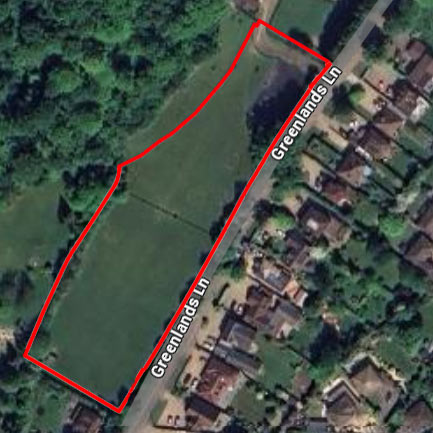
For those opposed to the development application on Greenlands Lane, 14th October brought good news. The appeal to the Planning Inspectorate was dismissed. This is also an important judgement in a broader context.
Planning decisions, especially contentious ones, come down to a balance. Responses to PCA’s #WeLovePrestwood survey also reflected the need for balance: a very powerful sense that we should protect our environment, green space and village feel, but also an understanding of the need for appropriate new housing.
In this case, the Government-appointed inspector agreed that the development in itself has much to commend it, in particular the provision of 18 dwellings in an area where the outlook for future housing delivery is very uncertain. But the issue has always been the location: on an edge-of-settlement site within Green Belt, within Chilterns National Landscape.

This was the THIRD time the Planning Inspectorate has considered appeals on this site, by the same parties:
View Greenlands Lane site planning history
- PL/21/1676/OA: Outline application for the erection of 12 dwellings including 5 affordable homes, and the conversion of stables block to provide a further 1 dwelling.
- PL/21/4751/OA: Outline application for the erection of 10 dwellings including 4 affordable homes. Heard together and dismissed 14th October 2022.
- PL/23/0377/OA: Outline application for the erection of 4 detached dwellings and garaging. Dismissed 29th April 2024.
- PL/25/1732/OA: Outline application for the erection of 18 dwellings including 9 affordable units. Dismissed 14th October 2026.
The most recent application was framed in the context of the new (December 2024, updated August 2026) National Planning Policy Framework (NPPF). This made significant changes to conditions regarding Green Belt, introducing the concept of ‘Grey Belt’, and the applicants sought to test this to the full. It also played on the fact of ever more acute housing needs within Buckinghamshire, and the absence of an updated Local Plan for Buckinghamshire.
What next for the Greenlands Lane site?
The dismissal of the appeal puts the ball firmly back in the applicants’ court. The judgement does clarify at least one matter in their favour, namely the confirmation of the site as Grey Belt.
But whilst acknowledging the site as Grey Belt, the decision stated that not all the conditions (“Golden Rules”) to build on Grey Belt had been satisfied. In particular, provision of new green space, or improvements to publicly accessible existing green space. But it also stated that this development would cause harm to the ‘openness and permanence of the Green Belt’.
Perhaps even more crucial was the opinion regarding National Landscape, for which there are specific protections. At appeal, the applicants presented ‘new evidence’ in the form of a landscape statement by a firm of landscape architects. The statement cast doubt on the value of this particular site, contending that it does not deliver the vast majority of the attributes for which the National Landscape has been designated. The judgement did not specifically refer to this document, but gave no validity to selective analysis of an apparently less valuable part of the National Landscape.
The applicants will be studying this judgement to decide on their next move. For example, we cannot conclude absolutely from the judgement whether the openness and permanence of this site would be harmed by ANY development, or whether a smaller or reconfigured proposal might be workable. In our view, the judgement in respect of harm to the National Landscape looks particularly tricky.
No doubt other potential developers around Prestwood and further afield will also be studying the judgement closely.
The Decision – Pros and Cons
Below we seek to distil down the Government inspector’s decision into a simple summary of the pros and cons as he judged them. We have picked out in italics various verbatim sections that illustrate relevant considerations.
Pro’s:
Appeal site status now agreed as Grey Belt (within the Green Belt).
‘Substantial weight’:
- 18 dwellings represent meaningful contribution towards addressing housing deficit.
- 9 affordable dwellings – ‘significant social benefit’.
‘Moderate weight’
- Reuse of previously developed land.
- Proposed off-highway development works, improving pedestrian connectivity
‘Modest weight’
- Biodiversity net gain – modest due to nature and scale.
- Accessibility
- Socio-economic benefits associated with the construction and subsequent occupation of the proposed dwellings, including additional support for local facilities and services.
Cons:
Green Belt Openness and Permanence
The introduction to Chapter 13 of the NPPF, “Protecting Green Belt Land”, states: “The objective of Green Belt policy, as set out in this chapter, is to prevent urban sprawl by keeping land permanently open. The government attaches great importance to Green Belts, the essential features of which are their openness and permanence.”
These essential features – openness and permanence – were key considerations in the inspector’s evaluation of potential harms.
“…the permanent loss of the paddocks and weakening of the soft settlement edge would erode the local pattern of openness, enclosure and vegetation characteristic of this part of the Great Kingshill Settled Plateau. Although the wider character area and National Landscape would remain largely unchanged, the proposal would cause a material and lasting erosion of local landscape character.
…More fundamentally, Green Belt openness has both spatial and visual dimensions. The introduction of 18 dwellings, together with associated infrastructure and domestic paraphernalia, would substantially erode both dimensions of the site’s openness and cause significant harm to the Green Belt.”
“…the proposal would cause harm by reason of inappropriateness, substantial erosion of Green Belt openness, moderate and localised harm to the Chilterns National Landscape, and minor harm to the significance of Hampden Farm and Hampden Farm Barn through changes to the shared wider setting of the historic farmstead. The benefits, taken together, weigh substantially in favour of the proposal. However, they do not clearly outweigh the Green Belt and other harm identified. Consequently, the very special circumstances required by Framework Policy GB6 (Control of Development in the Green Belt) do not exist.”
National Landscape
The judgement attached “substantial weight” to the identified harm to the National Landscape.
The appellants had introduced a landscape statement (claimed to be ‘new evidence’) from a firm of landscape architects. The statement cast doubt on the value of this particular site, contending that it does not deliver the vast majority of the attributes for which the National Landscape has been designated, nor does it deliver the majority of the attributes contributing to the local character.
The judgement disagreed, stating that one should not cherry pick (our words) specific apparently less attractive sites.
“Although different parts of a National Landscape may exhibit different characteristics and sensitivities, the designation and statutory duty apply throughout it. The site cannot therefore be treated as expendable merely because other areas may be more distinctive or sensitive. The relevant consideration is the effect of the proposal on the site within its particular landscape context… “
Within its particular landscape context, the judgement stated that “the site’s open paddocks, established boundaries and relationship with adjacent ancient woodland reflect the characteristic pattern of grazed land, vegetation, openness and enclosure. It therefore makes a limited but positive contribution to the local character and natural beauty of this part of the National Landscape….
The development of 18 dwellings, together with roads, parking, hard surfacing, gardens and associated domestic activity, would occupy a substantial proportion of the site. Whatever detailed layout were pursued, development of that scale would replace its predominantly open paddock character with a distinctly suburban form. This would diminish the site’s openness and relationship with the adjoining woodland, weakening the undeveloped transition between Prestwood and the surrounding countryside…
Although the wider character area and National Landscape would remain largely unchanged, the proposal would cause a material and lasting erosion of local landscape character….”
Achievement of ‘Golden Rules’ requirement for Grey Belt Development
Whilst the site has now been established as Grey Belt, in order to develop within the Green Belt, the application needs to pass certain ‘Golden Rules’ if development is to be considered not inappropriate.
Two of these tests, affordable housing and infrastructure, were met, with 50% of dwellings affordable, and local infrastructure improvements.
However, the application fell down on provision of new green space, or improvements to publicly accessible existing green space. The inspector pointed out that there was no more than generalised comment about such provision, perhaps on an adjacent site. Whilst acknowledging that this was an outline planning application, the essential need to pass the ‘Golden Rule’ had been ignored, and certainly not proven. This was, in fact, a point raised by PCA in its analysis of the original application, and again at the Appeal, suggesting that the determination to develop the site “to the fullest extent possible” was probably inconsistent with the need to provide required green space.
During the appeal hearing, the appellants’ King’s Counsel sought to diminish the importance of the ‘Golden Rules’ by citing that the NPPF’s wording: “all of the following contributions (‘Golden Rules’) should be made”. Drawing the distinction between ‘should’ and ‘must’, he suggested there may be grounds for judicial review if the Inspector failed to see it his way.
The judgement dealt with this as follows:
“During the hearing, the appellant emphasised that Framework Policy GB8 states that the Golden Rules contributions “should”, rather than “must”, be made. While that reflects the policy’s wording, the use of “should” does not remove the need for clear justification where a contribution is neither proposed nor secured. Policy GB8 affords substantial weight to compliance with the Golden Rules and identifies circumstances in which viability evidence may demonstrate that compliance is not possible. No such evidence, or other robust justification for omitting the green-space contribution, has been provided.”
Heritage Assets
The inclusion of the need to preserve the settings of three Listed buildings – Hampden Farm, Hampden Farm Barn and Woodlands – was a bit of a surprise, as it had not been included by Buckinghamshire Council among reasons for concern and refusal. The inspector noted that the proposal would cause ‘minor harm’ in relation to the context of Hampden Farm and Hampden Farm Barn (“replacing the open paddocks with 18 dwellings and associated infrastructure would introduce a suburban form of development into land that currently contributes to an understanding of the farmstead’s agricultural origins”).